Quick answer: Percentage change = (new value − old value) ÷ old value × 100. A price rising from $80 to $100 is up 25%. Because the base changes, a 20% fall needs a 25% rise to recover: $100 → $80 → $100 is +25%. To find the original value before a change, divide by (1 ± rate).
Percentages are the language of prices, raises, returns and discounts. A handful of formulas cover most everyday cases, and a few traps cause most errors.
Key takeaways
- Percent change = (new − old) ÷ old × 100.
- To increase X by p%: X × (1 + p/100). To decrease: X × (1 − p/100).
- To undo a change, divide by the factor, not subtract the percent.
- A percentage-point change is not the same as a percent change.
- Losses need larger percentage gains to recover.
Core formulas
| Task | Formula | Example |
|---|---|---|
| Percent change | (new − old) ÷ old × 100 | ($100 − $80) ÷ $80 = 25% |
| Increase by p% | X × (1 + p/100) | $80 × 1.25 = $100 |
| Decrease by p% | X × (1 − p/100) | $100 × 0.80 = $80 |
| Find original after increase | final ÷ (1 + p/100) | $120 ÷ 1.20 = $100 |
| Find original after discount | final ÷ (1 − p/100) | $80 ÷ 0.80 = $100 |
| Percent of a number | X × p/100 | 15% of $60 = $9 |
| What percent is A of B | A ÷ B × 100 | $9 ÷ $60 = 15% |
The recovery problem
Percentage needed to get back after a loss: gain = 1 ÷ (1 − loss) − 1.
| Loss | Gain needed to recover |
|---|---|
| 10% | 11.1% |
| 20% | 25.0% |
| 30% | 42.9% |
| 50% | 100.0% |
| 70% | 233.3% |
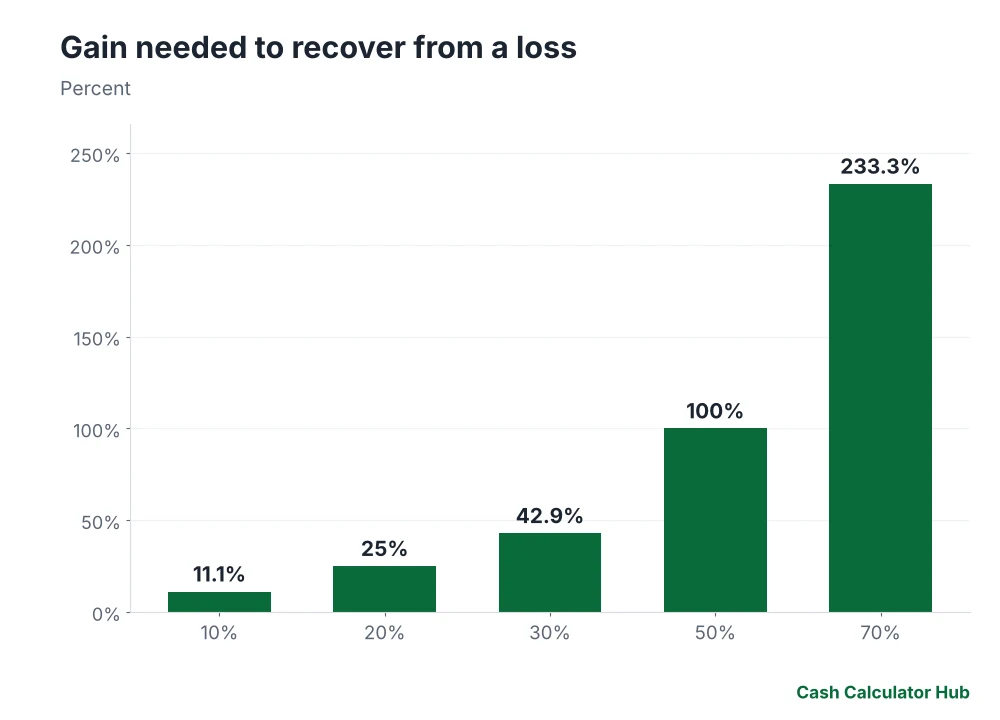
This matters for investing: a 50% fall needs a 100% rise. See ROI, IRR and CAGR.
Percentage points vs percent
If an interest rate rises from 4% to 5%, it increased by 1 percentage point, which is a 25% relative increase.
Common mistakes
- Subtracting to reverse. A price of $120 after a 20% increase was $100, not $96.
- Adding successive changes. +10% then −10% is −1%, not 0: 1.10 × 0.90 = 0.99. See stacking discounts.
- Using the wrong base. Always divide by the old value.
Real-world examples
| Situation | Calculation | Result |
|---|---|---|
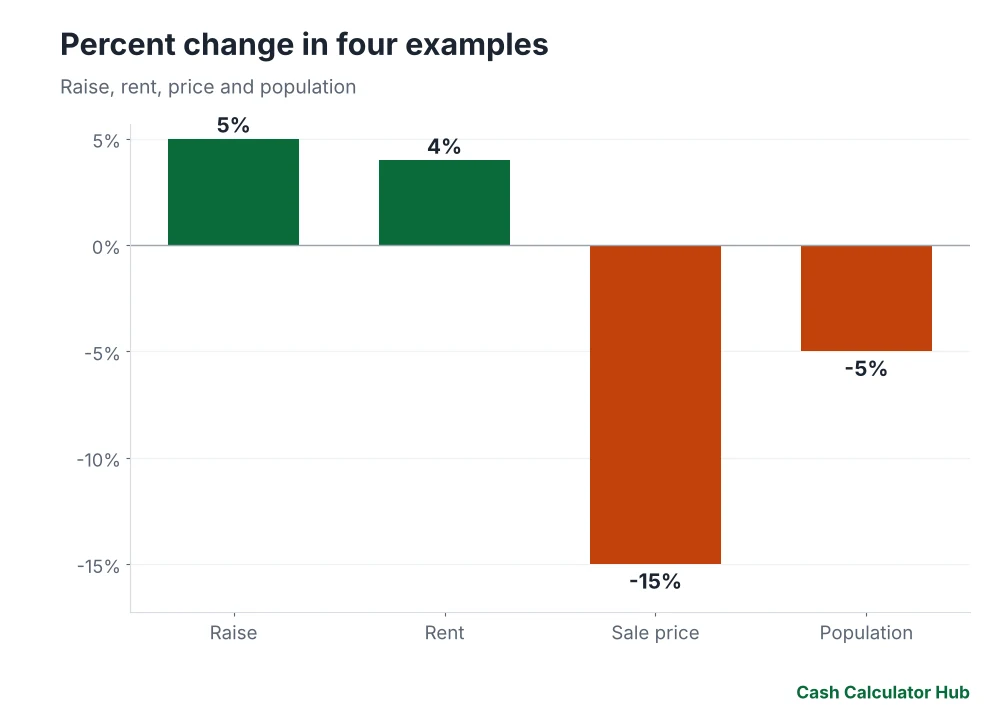
| Raise from $62,000 to $65,100 | (65,100 − 62,000) ÷ 62,000 | 5.0% |
| Rent $1,500 up 4% | 1,500 × 1.04 | $1,560 |
| Sale price $68 after 15% off | 68 ÷ 0.85 | $80 original |
| Population 80,000 to 76,000 | (76,000 − 80,000) ÷ 80,000 | −5.0% |
Related ideas
Real raises vs inflation: real raise formula. Markups and margins: margin vs markup. Sales tax: sales tax by state.
Tools
Use the percentage calculator, discount calculator and sales tax calculator. More: business and everyday tools.
Frequently asked questions
How do you calculate percentage increase?
Subtract the old value from the new, divide by the old value and multiply by 100.
How do you calculate percentage decrease?
The same formula; a negative result shows a decrease.
Why does a 50% loss require a 100% gain?
Because the gain applies to a smaller base: $100 → $50 requires doubling the $50.
How do I find the original price before a discount?
Divide the sale price by (1 minus the discount rate).
What is a percentage point?
The absolute difference between two percentages, for example 4% to 5% is one percentage point.
Sources and further reading
How the numbers were made: Every figure on this page was calculated from the formulas and assumptions stated above and rounded to the nearest dollar. Rates, limits and rules are for 2026 unless noted; confirm current figures with the sources listed before acting.
Keep reading
- Margin vs Markup: The Difference, the Formulas and a Conversion Table
- What Was $100 Worth in 2000? Inflation, Calculated
- ROI vs IRR vs CAGR: Which Return Number Should You Trust?
- Payback Period and Discounted Payback: How Fast Does an Investment Return Your Money?
- Break-Even Analysis: How Many Units or How Much Revenue You Need to Cover Costs
- Gross Margin vs Operating Margin vs Net Margin: What Each Tells You
This guide is general information, not financial, tax or legal advice. Figures use stated assumptions and 2026 rules and will differ from your situation; check current rules and talk to a licensed professional before you decide. Full disclaimer.