Quick answer: RMDs start at 73 (born 1951-1959) or 75 (born 1960+). On an $800,000 IRA the first RMD is about $30,189.
Tax-deferred accounts are a deal: you skip tax now and pay it later. “Later” is set by the IRS through required minimum distributions, and missing one is one of the more expensive mistakes in retirement.
Who has to take them, and when
Under SECURE 2.0:
- Born 1951 to 1959: RMDs start at age 73.
- Born 1960 or later: RMDs start at age 75.
They apply to traditional IRAs, SEP and SIMPLE IRAs and employer plans such as 401(k) and 403(b). Roth IRAs have no RMDs for the original owner, and Roth 401(k) accounts no longer require them either, starting in 2024.
Your first RMD is due by April 1 of the year after you reach the required age. Later ones are due December 31 each year. If you delay your first until April 1, you take two in the same year, which could push you into a higher bracket.
The formula
RMD = account balance on December 31 of last year ÷ distribution period (IRS table)
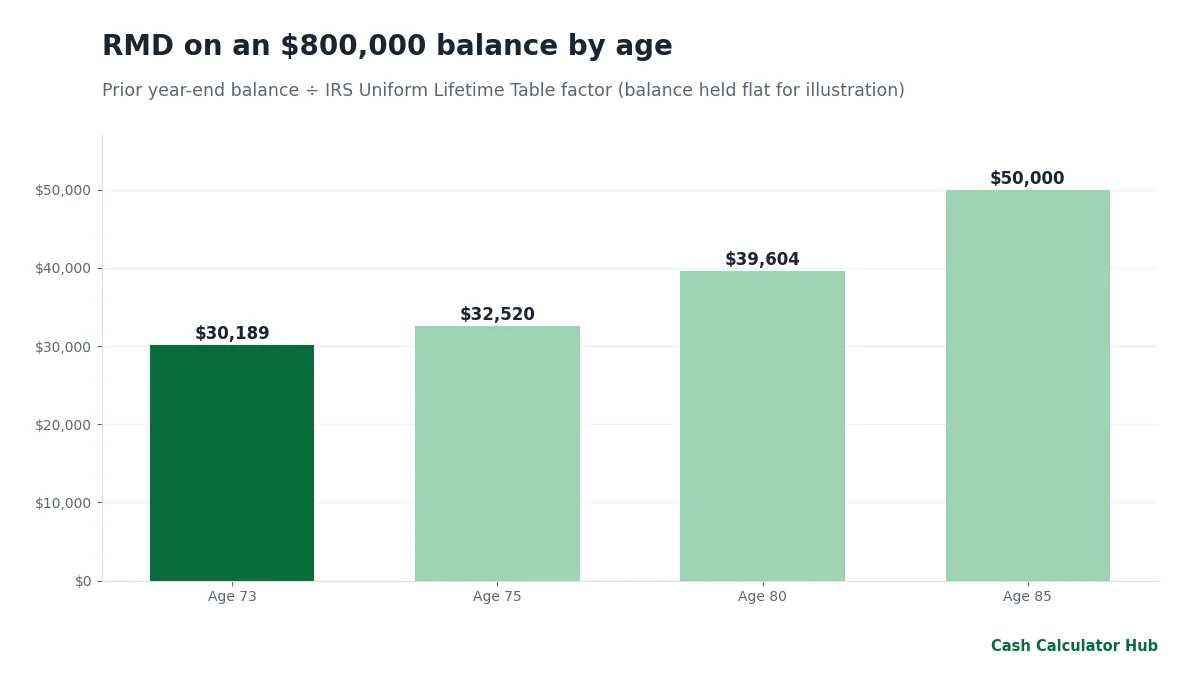
For most people the Uniform Lifetime Table applies. Some factors: age 73 is 26.5, age 75 is 24.6, age 80 is 20.2, age 85 is 16.0.
On an $800,000 balance:
| Age | Factor | RMD | % of balance |
|---|---|---|---|
| 73 | 26.5 | $30,189 | 3.8% |
| 75 | 24.6 | $32,520 | 4.1% |
| 80 | 20.2 | $39,604 | 5.0% |
| 85 | 16.0 | $50,000 | 6.2% |
If your spouse is more than 10 years younger and is the sole beneficiary, a different table gives a smaller RMD. With several IRAs, you calculate each but can take the total from any of them; 401(k)s must be handled account by account.
The penalty
Miss an RMD and the excise tax is 25% of the amount you should have taken, reduced to 10% if you fix it within two years. That used to be 50%. It is still a lot on a $30,000 shortfall: $7,500.
Strategies to soften the tax bite
- Qualified charitable distributions (QCDs). From age 70½ you can send up to a limit (over $100,000 per year, indexed) straight from an IRA to charity. It counts toward your RMD and is not taxable.
- Roth conversions before RMD age. In low-income years (say 62 to 72), converting some traditional money to Roth at a low bracket shrinks the future RMD. Weigh the tax cost now against the saving later, and see Roth versus traditional.
- Keep working. If you are still employed and do not own 5% or more of the company, you can often delay RMDs from that employer’s 401(k).
- Take distributions in kind or earlier than required if you need the income.
- Plan around Medicare. Higher income can trigger IRMAA surcharges, two years later.
Plan for it years ahead
The tax-deferred balance you built through 401(k) and IRA contributions is not entirely yours; a portion is owed to the IRS. Use the RMD calculator to project future distributions, and the income tax calculator to see the effect on your bracket. Combine with Social Security timing in the Social Security guide. See also all retirement calculators.
What a QCD saves, in numbers
Say your RMD is $30,189 and you are in the 22% bracket. If you give $10,000 to charity as a qualified charitable distribution, your taxable RMD drops to $20,189, saving about $2,200 of federal tax compared with taking the full amount, paying tax and then donating (and not itemizing). It also keeps your adjusted gross income lower, which can reduce taxes on Social Security and Medicare premiums.
A simple RMD checklist
- Find your December 31 balance for every tax-deferred account.
- Look up your age factor in the IRS table, or use the RMD calculator.
- Decide which account to draw from (IRAs can be combined; 401(k)s cannot).
- Set up withholding or estimated taxes so you do not face a surprise bill.
- Calendar the deadline, and consider taking the withdrawal early in the year to avoid forgetting.
- Update beneficiaries.
Do I have to withdraw if I do not need the money?
Yes. You must take it, but you can reinvest it in a taxable account after paying tax.
What happens to RMDs when I die?
Beneficiaries usually must empty the inherited account within 10 years, and some must take annual distributions during that time.
Which age applies to me?
If you were born in 1959 it is 73; in 1960 or later it is 75.
Are RMDs required from a Roth IRA?
Not for the original owner.
Sources and further reading
How the numbers were made: Every figure on this page was calculated from the formulas and assumptions stated above and rounded. Rates, limits and rules are for 2026 unless noted; confirm current figures with the sources listed before acting.
Keep reading
- Roth vs Traditional 401(k) and IRA: How to Decide
- 2026 401(k) and IRA Contribution Limits, Explained
- Social Security at 62 vs 67 vs 70: When Does Waiting Pay Off?
- The 4% Rule: Safe Withdrawal Rates From 3% to 5%, With Real Numbers
- Roth Conversion Explained: When Paying Tax Now Beats Paying Later
- Pension Lump Sum vs Monthly Payments: How to Compare the Offers
This guide is general information, not financial, tax or legal advice. Figures use stated assumptions and 2026 rules and will differ from your situation; check current rules and talk to a licensed professional before you decide. Full disclaimer.