
Quick answer: Present value = future value ÷ (1 + r)^n. Discounting five $14,000 annual payments at 8% gives a present value of $55,898; subtracting a $50,000 investment leaves a net present value (NPV) of $5,898. A positive NPV means the project earns more than the discount rate; its IRR here is 12.4%.
Money received sooner can be invested, so it is worth more than the same amount later. The time value of money underlies loans, investments, annuities, pensions and business decisions. Three formulas handle most cases: future value, present value and NPV.
Key takeaways
- Future value: FV = PV × (1 + r)^n.
- Present value: PV = FV ÷ (1 + r)^n.
- NPV = sum of discounted cash flows − initial investment.
- Positive NPV: accept at that discount rate; the IRR is the rate where NPV is zero.
- Higher discount rates and longer waits reduce present value.
Future value and present value
| Question | Formula | Example |
|---|---|---|
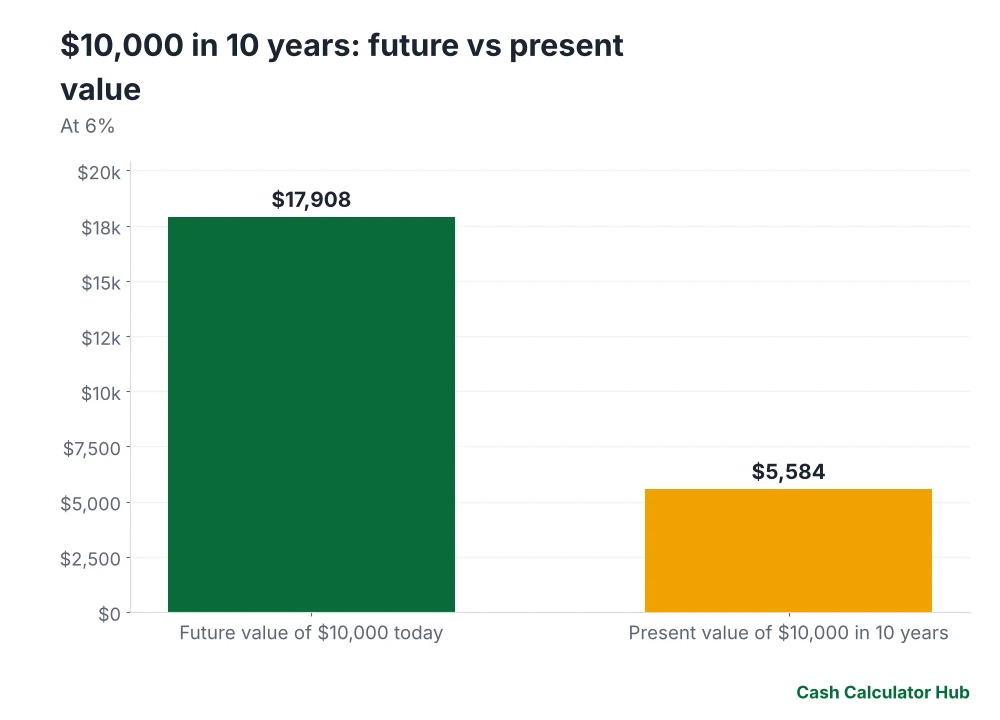
| What will $10,000 be worth in 10 years at 6%? | PV × (1+r)^n | $17,908 |
| What is $10,000 in 10 years worth today at 6%? | FV ÷ (1+r)^n | $5,584 |
| What is $100 a year for 20 years worth today at 5%? | annuity PV | $1,246 |
Effect of the discount rate
Present value of $10,000 received in 10 years:
| Discount rate | Present value |
|---|---|
| 2% | $8,203 |
| 4% | $6,756 |
| 6% | $5,584 |
| 8% | $4,632 |
| 10% | $3,855 |
NPV example
Invest $50,000 now to receive $14,000 at the end of each year for 5 years; discount rate 8%.
| Year | Cash flow | Discount factor | Present value |
|---|---|---|---|
| 0 | −$50,000 | 1.000 | −$50,000 |
| 1 | $14,000 | 0.926 | $12,963 |
| 2 | $14,000 | 0.857 | $12,003 |
| 3 | $14,000 | 0.794 | $11,114 |
| 4 | $14,000 | 0.735 | $10,290 |
| 5 | $14,000 | 0.681 | $9,528 |
| NPV | $5,898 |

The project’s IRR is 12.4%, above the 8% hurdle. See ROI, IRR and CAGR.
Applications
- Pension lump sum vs payments: see pension decisions.
- Mortgage points: see points break-even.
- Lease vs buy: see lease vs buy.
- Inflation: discount using the inflation rate to see real value; see what $100 was worth.
- Payback: see discounted payback.
Choosing a discount rate
Use the return you could earn on an alternative investment of similar risk, or the cost of borrowing. Higher risk deserves a higher rate.
Tools
Use the present value calculator, future value calculator, IRR calculator and annuity payout calculator. More: business and everyday tools.
Frequently asked questions
What is the time value of money?
The principle that money available now is worth more than the same amount in the future because it can earn returns.
How do you calculate present value?
Divide the future amount by (1 + r) raised to the number of years.
What is NPV?
Net present value: the sum of discounted future cash flows minus the initial investment.
What does a positive NPV mean?
The investment earns more than the required discount rate and adds value.
How is IRR related to NPV?
IRR is the discount rate at which NPV equals zero.
Sources and further reading
How the numbers were made: Every figure on this page was calculated from the formulas and assumptions stated above and rounded to the nearest dollar. Rates, limits and rules are for 2026 unless noted; confirm current figures with the sources listed before acting.
Keep reading
- ROI vs IRR vs CAGR: Which Return Number Should You Trust?
- Compound Interest on $10,000: What It Becomes in 10, 20 and 30 Years
- What Was $100 Worth in 2000? Inflation, Calculated
- The True Cost of an Employee: Why a $70,000 Salary Costs About $90,000
- How to Set a Freelance Hourly Rate: From Income Goal to Billable Hours
- Depreciation Methods: Straight-Line vs Declining Balance vs Sum-of-the-Years’ Digits
This guide is general information, not financial, tax or legal advice. Figures use stated assumptions and 2026 rules and will differ from your situation; check current rules and talk to a licensed professional before you decide. Full disclaimer.