Quick answer: On a $100,000 salary the realistic home price is about $280,000–$305,000 at today's rates.
Search for this question and you will find answers anywhere from $250,000 to $500,000. They are all “right,” which is the problem. A $100,000 salary is one input. The rate you get, the size of your down payment, what you already owe each month and the tax and insurance bill on the specific house move the answer by six figures.
So instead of handing you one number, here is how a lender builds it, with a table you can reuse for your own situation.
The two ratios that decide your limit
Most lenders look at two percentages of your gross (before-tax) monthly income. On $100,000 that is $8,333 a month.
- Front-end ratio, about 28%: your total housing payment (principal, interest, property tax, insurance, PMI and any HOA dues) should not pass $2,333.
- Back-end ratio, about 36%: housing plus every other monthly debt (car loan, student loans, minimum card payments) should not pass $3,000.
Plenty of lenders will go higher. FHA and some conventional programs approve borrowers up to 43% or even 50% on the back end. That is permission, not advice. If you want the full picture of how lenders read these numbers, our guide to the debt-to-income ratio for a mortgage walks through it.
What $8,333 a month buys at different rates
Mortgage rates rose through September 2026 and the Freddie Mac weekly average for a 30-year fixed loan moved above 7% in early October, so a table built on 5% or 6% would flatter you. This one uses the 28% front-end limit and a 30-year fixed loan, with property tax at 1.1% of the price and $2,100 a year for insurance. Put less than 20% down and I have added PMI at 0.6% of the loan per year.
| Mortgage rate | 5% down | 10% down | 20% down |
|---|---|---|---|
| 6.5% | $292,000 | $306,000 | $361,000 |
| 7.0% | $280,000 | $293,000 | $346,000 |
| 7.5% | $269,000 | $282,000 | $332,000 |
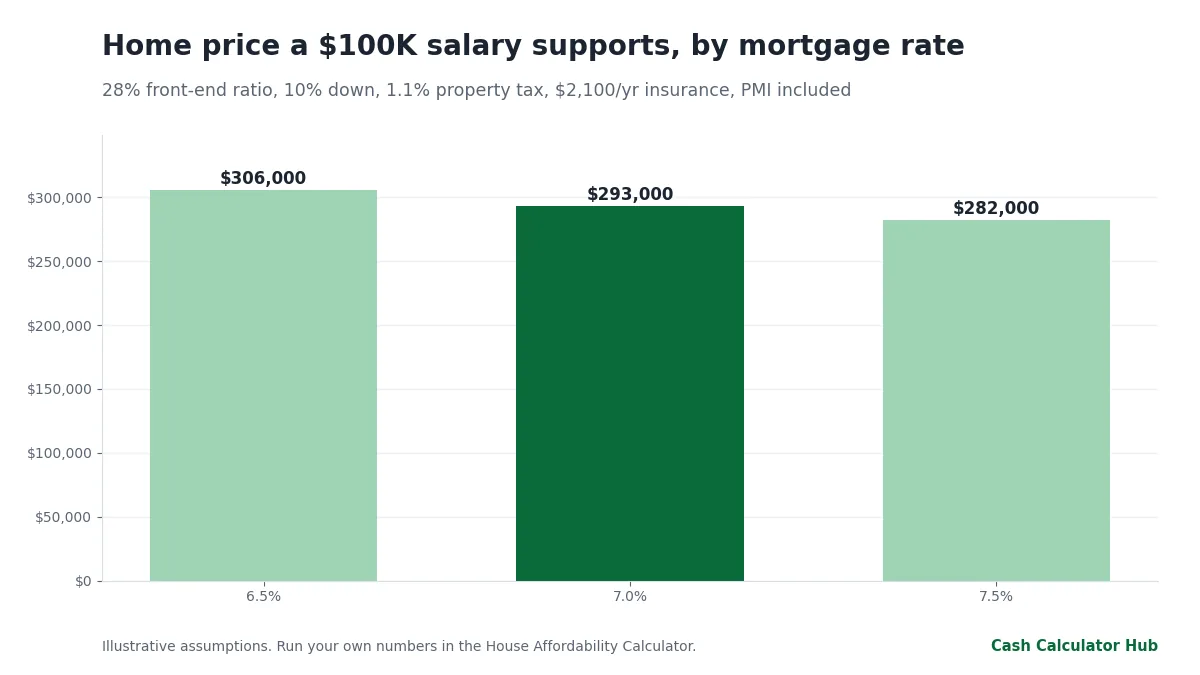
Two things stand out. First, rate matters more than most buyers expect: moving from 6.5% to 7.5% costs about $24,000 of house on the same paycheck. Second, putting 20% down raises your ceiling by a smaller amount than you might guess, because you also need that much more cash on closing day. A bigger down payment is great for your monthly payment; it is not a magic multiplier on the price.
The debt trap nobody mentions in the headline numbers
The table above assumes you owe nothing else. Almost nobody is in that position. Here is the same $100K salary at 7% with 10% down, with different amounts of other monthly debt:
| Other monthly debt | Housing budget | Max home price |
|---|---|---|
| $0 | $2,333 | $293,000 |
| $700 | $2,300 | $289,000 |
| $1,000 | $2,000 | $248,000 |
| $1,400 | $1,600 | $194,000 |
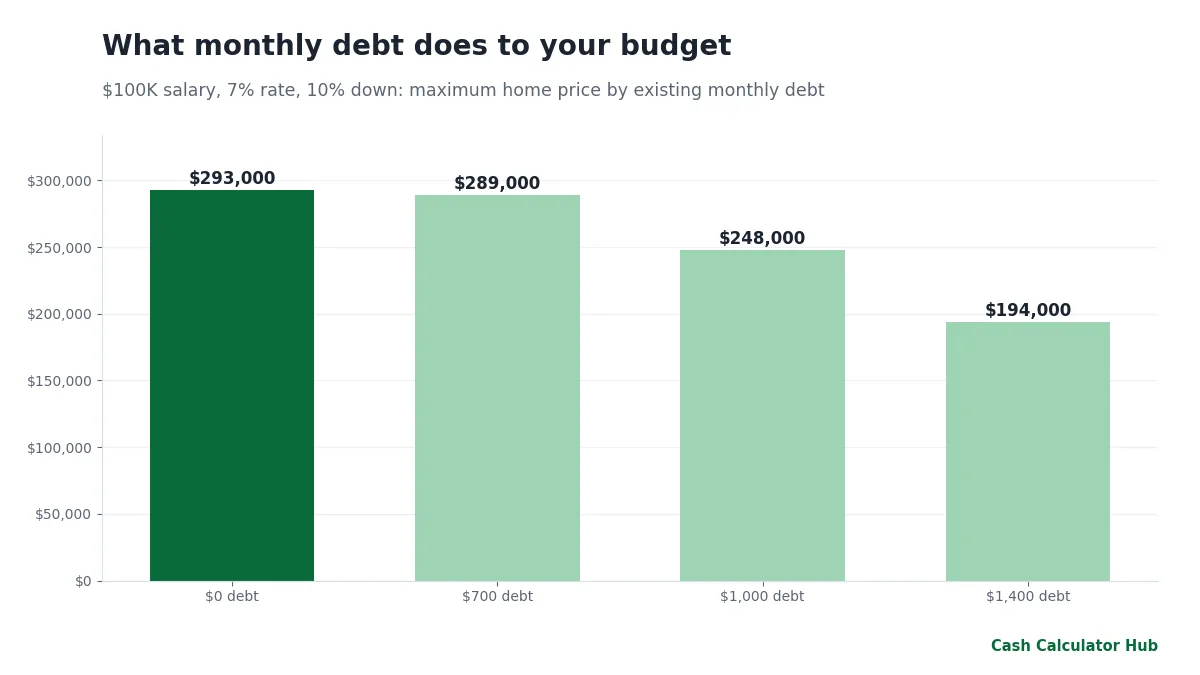
With a 28% front-end cap, the first $667 of other monthly debt does not move your limit at all, because the housing rule is already the tighter one. Past that point the 36% rule takes over, and every $100 of monthly debt costs roughly $14,000 of house. A $400 car payment plus a $350 student loan is not unusual, and that combination alone starts to bite. If you are close to a decision, paying off a small loan before you apply can raise your limit more than another year of saving for a down payment.
Cash you need on closing day
The price is not the only number that has to fit. At 10% down on a $293,000 house you need $29,300 for the down payment, plus closing costs that commonly land between 2% and 5% of the price, so another $5,860 to $14,650. Add a repair and moving cushion. Our down payment calculator turns that total into a monthly savings target.
A realistic example
Take a buyer earning $100,000 with $300 a month in other debt who finds a $293,000 house, puts 10% down and gets a 7% rate:
- Principal and interest on the $263,700 loan: $1,754
- Property tax: $269
- Insurance: $175
- PMI: $132
- Total: $2,330 a month, or 28% of gross income
Against take-home pay of roughly $6,598 a month (after 2026 federal income tax and payroll tax, before any state tax), the payment takes about 35% of what actually lands in your account, before a single grocery bill. If your net pay feels tight, the take-home paycheck calculator shows what actually lands in your bank account, and our breakdown of what $100,000 is after taxes has the full picture.
What if your income is a little higher or lower?
Same assumptions as above (7% rate, 10% down, no other debt, 28% front-end ratio), for neighboring salaries:
| Salary | Monthly gross | Housing budget | Max home price |
|---|---|---|---|
| $70,000 | $5,833 | $1,633 | $198,000 |
| $80,000 | $6,667 | $1,867 | $230,000 |
| $100,000 | $8,333 | $2,333 | $293,000 |
| $120,000 | $10,000 | $2,800 | $357,000 |
| $150,000 | $12,500 | $3,500 | $452,000 |
Buying power is almost linear in income, so you can scale: every extra $10,000 of salary adds roughly $32,000 to the price. Two earners combining incomes can do the same math with the joint figure, but remember that both people’s debts count too.
How to use the calculators on this
- Open the house affordability calculator and enter your income, monthly debts and down payment.
- Switch the rate between 6.5%, 7% and 7.5% to see how sensitive your result is.
- Take the price you like and test it in the mortgage calculator with your real tax and insurance quotes.
- Compare it with renting using the rent versus buy breakdown before you commit.
Mistakes that shrink your real budget
- Using the approval amount as your budget. Lenders approve you for what the ratios allow, not for what leaves room for savings, travel and repairs.
- Forgetting HOA and insurance. In some states insurance alone runs $4,000 a year or more. A $400 monthly HOA fee removes roughly $55,000 of price from your range.
- Ignoring maintenance. Plan on 1% of the home’s value per year for repairs, on average.
- Shopping one lender. A quarter-point difference in rate is worth about $6,000 of price at this income, and quotes for the same borrower often differ by that much.
Browse the rest of our mortgage and real estate calculators if you want to test a different scenario.
Can I afford a $400,000 house on a $100,000 salary?
Usually only with a large down payment, low other debt or a lower rate. At 7% with 20% down and no other debts the 28% limit supports about $346,000; at 10% down it is closer to $293,000.
How much should my down payment be on a $100K income?
Aim for at least 10% if you can, and 20% to avoid PMI. If you have less, FHA loans start at 3.5% down but add mortgage insurance. See how much down payment you need.
Does a $100K salary change if I live in a high-cost state?
Yes. Property tax and insurance vary a lot by state. Enter your own figures instead of the national averages used here.
Do lenders use gross or net income?
Gross. That is why you should check the payment against your take-home pay as well.
Sources and further reading
How the numbers were made: Every figure on this page was calculated from the formulas and assumptions stated above and rounded. Rates, limits and rules are for 2026 unless noted; confirm current figures with the sources listed before acting.
Keep reading
- Debt-to-Income Ratio for a Mortgage: What Lenders Allow
- How Much Is a $100,000 Salary After Taxes in 2026?
- Rent vs Buy: How Long Until Buying a Home Wins?
- Mortgage Payment on a $400,000 House: Real Numbers
- Pay Off Your Mortgage Early: What Extra Payments Really Save
- Mortgage Refinance Break-Even Point: Is It Worth It?
This guide is general information, not financial, tax or legal advice. Figures use stated assumptions and 2026 rules and will differ from your situation; check current rules and talk to a licensed professional before you decide. Full disclaimer.