
Quick answer: The standard rule is that rent should be no more than 30% of your gross monthly income: $1,500 a month on a $60,000 salary. Many landlords require annual income of 40 times the monthly rent. A better personal test is rent at or below about one-third of take-home pay, adjusted for debts and savings goals.
Rent is usually the biggest monthly expense, so getting it right sets the tone for the whole budget. Three common tests give different answers. Knowing how each works helps you choose a number you can sustain while still saving.
Key takeaways
- 30% rule: rent ≤ 30% of gross income.
- 40× rule: annual income ≥ 40 × monthly rent (about 3.33 times monthly rent in monthly income).
- Take-home test: rent around 30% to 35% of net pay, less if you have debt.
- Add utilities, renter’s insurance and parking when comparing homes.
- About half of renters are cost-burdened by the 30% definition, so tight budgets are common.
Rent by income
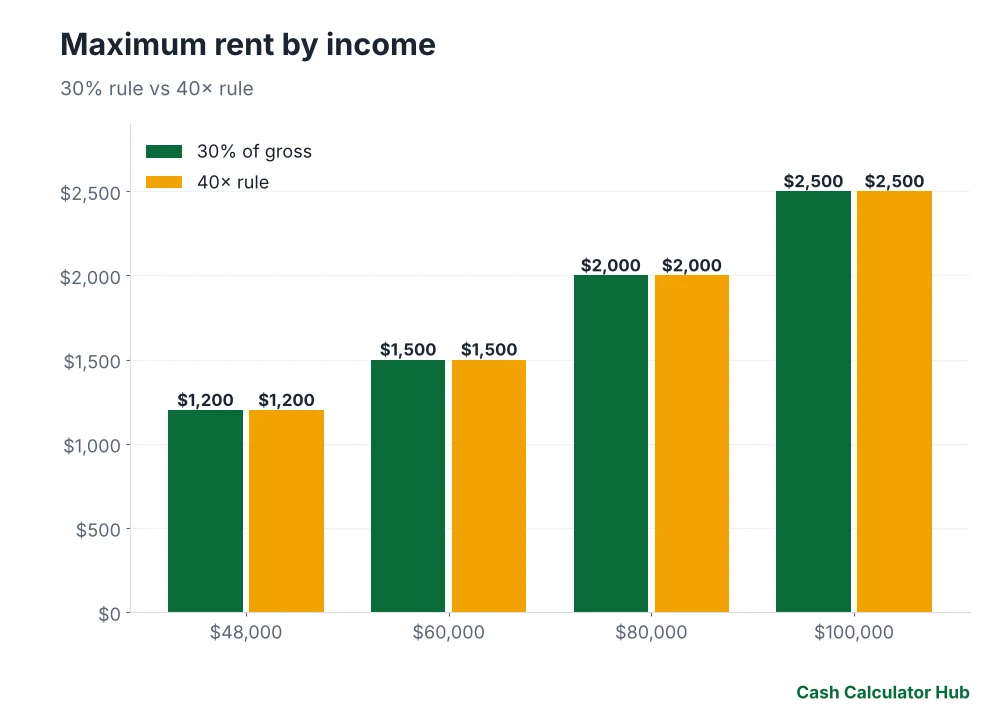
| Gross annual income | Gross monthly | 30% rule | 40× rule (max rent) | 25% (conservative) |
|---|---|---|---|---|
| $48,000 | $4,000 | $1,200 | $1,200 | $1,000 |
| $60,000 | $5,000 | $1,500 | $1,500 | $1,250 |
| $80,000 | $6,667 | $2,000 | $2,000 | $1,667 |
| $100,000 | $8,333 | $2,500 | $2,500 | $2,083 |
The take-home test
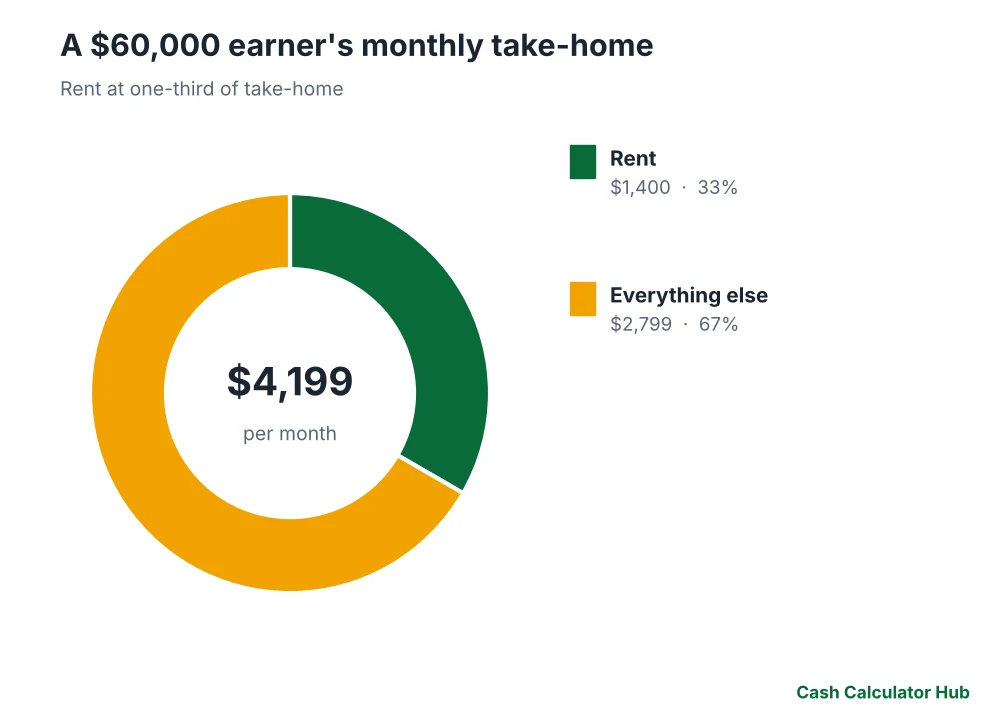
Gross-based rules ignore taxes. After federal tax and FICA a single earner of $60,000 takes home about $50,390; see take-home pay by salary. One-third of that per month is $1,400.
| Method | Rent at $60,000 salary |
|---|---|
| 30% of gross | $1,500 |
| 40× rule | $1,500 |
| One-third of take-home | $1,400 |
Adjust for your situation
- Student loans or car payment: lower your rent target. See debt-to-income.
- High-cost cities: you may need to exceed 30% temporarily; make up for it by cutting other costs.
- Roommates: splitting costs changes the picture; see splitting rent.
- Savings goals: if you want to save 20%, use the 50/30/20 rule to see how much is left for rent.
Total housing cost
| Item | Typical monthly range (assumed) |
|---|---|
| Rent | your target |
| Utilities | $100 – $250 |
| Renter’s insurance | $10 – $25 |
| Internet | $50 – $80 |
| Parking / transport | varies |
Rent versus buying
Rent also depends on how long you will stay and the alternative. See rent versus buy and the rent versus buy calculator.
Landlord requirements
Landlords usually ask for income of 3 times the rent, a credit check and sometimes a co-signer. Income documentation can include pay stubs, offer letters and tax returns.
Tools
Test your budget with the budget calculator, budget planner and house affordability calculator. More: budgeting tools.
Frequently asked questions
How much of my income should go to rent?
A common guideline is 30% of gross income or less, but 25% or less leaves more room for saving.
What is the 40 times rent rule?
Landlords often require annual income of at least 40 times the monthly rent.
Should rent be based on gross or net income?
Net income gives a more realistic picture because taxes can take 15% to 25% of pay.
How much rent can I afford on $60,000?
About $1,500 a month under the 30% rule.
Is paying more than 30% of income on rent bad?
It is common in expensive cities but leaves less room for savings and emergencies.
Sources and further reading
How the numbers were made: Every figure on this page was calculated from the formulas and assumptions stated above and rounded to the nearest dollar. Rates, limits and rules are for 2026 unless noted; confirm current figures with the sources listed before acting.
Keep reading
- Rent vs Buy: How Long Until Buying a Home Wins?
- The 50/30/20 Budget Rule: How It Works, and How to Adjust It
- How Much Salary Do You Need to Move to a New City?
- Pay Yourself First: How to Automate Saving So You Actually Do It
- Sinking Funds: How to Save for Irregular Expenses Without Wrecking Your Budget
- Zero-Based Budgeting: Give Every Dollar a Job (With a Worked Example)
This guide is general information, not financial, tax or legal advice. Figures use stated assumptions and 2026 rules and will differ from your situation; check current rules and talk to a licensed professional before you decide. Full disclaimer.