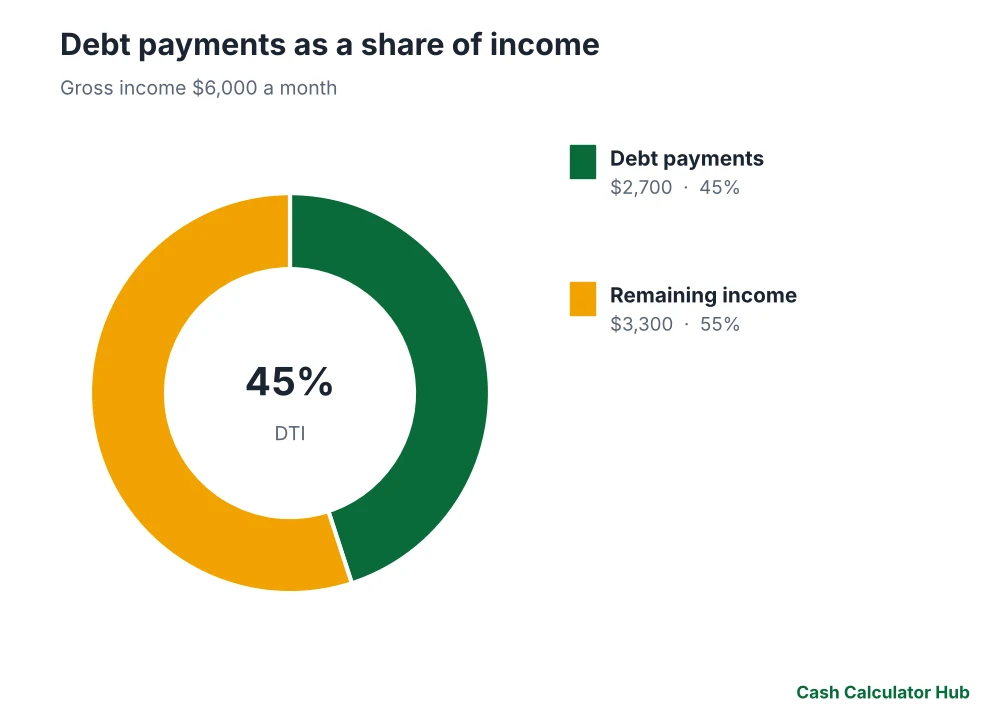
Quick answer: Debt-to-income (DTI) ratio is your total monthly debt payments divided by gross monthly income. With $2,700 of monthly debts and $6,000 of income, the back-end DTI is 45.0%. Many mortgage lenders prefer 36% or less and often cap it near 43% to 50%, depending on the loan type.
DTI is one of the main numbers lenders use to decide how much you can borrow. It is not a credit score; it measures whether your income can support a new payment. You can calculate it in a minute and improve it in predictable ways.
Key takeaways
- DTI = monthly debt payments ÷ gross monthly income.
- Front-end DTI counts housing costs only; back-end counts all debts.
- Typical conventional guidelines: housing ≤ 28%, total ≤ 36%, with approvals up to 43% to 50%.
- Utilities, groceries and insurance premiums are not counted as debts.
- Lower DTI by paying down debts, raising income or choosing a cheaper home.
Example
Gross monthly income: $6,000.
| Debt | Monthly payment |
|---|---|
| Rent or mortgage (PITI) | $1,800 |
| Car payment | $450 |
| Student loan | $300 |
| Credit card minimums | $150 |
| Total | $2,700 |
| Ratio | Calculation | Result |
|---|---|---|
| Front-end (housing) | $1,800 ÷ $6,000 | 30.0% |
| Back-end (all debts) | $2,700 ÷ $6,000 | 45.0% |
What counts
Counted: mortgage or rent (for new loan calculations the proposed payment), car loans, student loans, credit card minimums, personal loans, child support and alimony.
Not counted: utilities, phone, groceries, insurance premiums (other than escrowed), subscriptions and taxes.
Typical limits
| Loan type | Common maximum back-end DTI | |
|---|---|---|
| Conventional | 36% preferred, up to 45% to 50% with strong credit | |
| FHA | Up to 43%, higher with compensating factors; see [[p:fha-vs-conventional-loan | FHA vs conventional]] |
| VA | 41% guideline, residual income also matters; see [[p:va-loan-guide-funding-fee-and-benefits | VA loans]] |
| Personal loans / cards | Varies by lender |
How DTI changes affordability
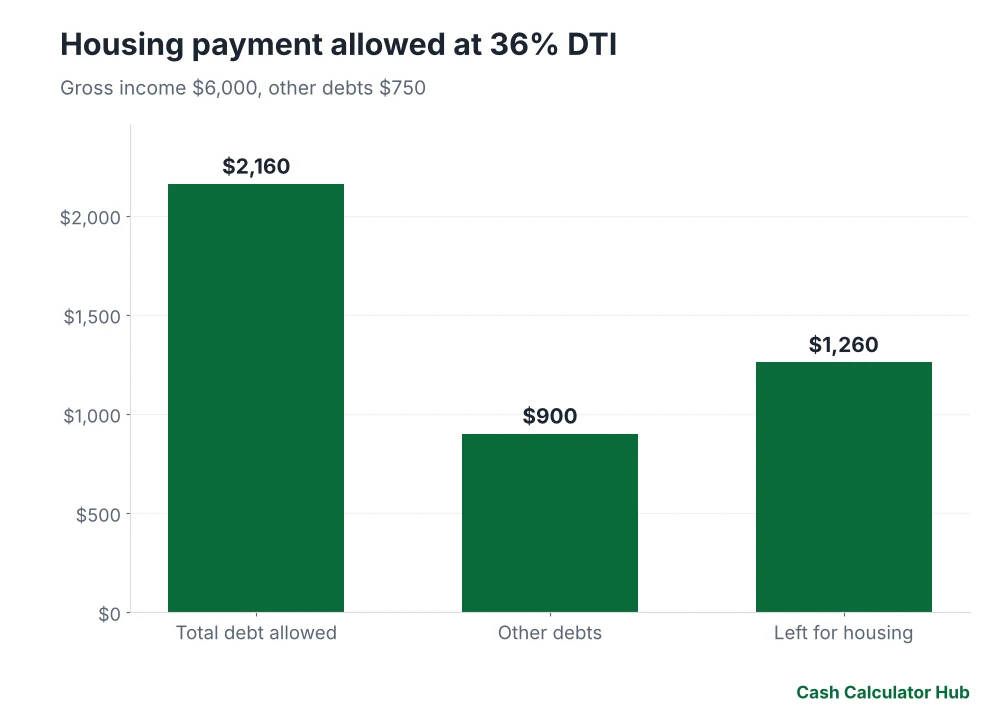
At a 36% back-end DTI limit and $6,000 income, total debt payments could reach $2,160; with $900 of non-housing debt, the housing payment would be limited to $1,260. See how much house you can afford.
Ways to improve DTI
- Pay down small balances; use avalanche or snowball.
- Refinance or consolidate into lower payments, if total cost improves; see debt consolidation.
- Avoid new debt before applying.
- Increase income with documented raises, side income or a co-borrower.
- Pay off an installment loan with few payments left; lenders may exclude loans with fewer than 10 payments remaining.
Related ratios
Credit utilization (card balances ÷ limits) affects credit scores; see credit score factors. The housing-only ratio is the front-end.
Tools
Use the debt-to-income calculator, house affordability calculator and mortgage calculator. See also DTI for a mortgage. More: loan calculators.
Frequently asked questions
What is a good debt-to-income ratio?
Below 36% is generally considered good; many lenders approve up to 43% or higher depending on the loan.
How do you calculate DTI?
Add monthly debt payments and divide by gross monthly income.
Does rent count in DTI?
For mortgage applications, the proposed housing payment counts. Current rent is usually replaced by that.
Do utilities count toward DTI?
No. Only debt obligations count.
How can I lower my DTI quickly?
Pay off small balances, avoid new debt and increase documented income.
Sources and further reading
How the numbers were made: Every figure on this page was calculated from the formulas and assumptions stated above and rounded to the nearest dollar. Rates, limits and rules are for 2026 unless noted; confirm current figures with the sources listed before acting.
Keep reading
- Debt-to-Income Ratio for a Mortgage: What Lenders Allow
- How Much House Can I Afford on a $100K Salary?
- Is Debt Consolidation Worth It? A $18,000 Credit Card Example
- APR vs APY: What’s the Difference and Why It Matters for Loans and Savings
- Credit Score Factors: What Moves Your Score and by How Much
- Balance Transfer Cards: Are They Worth the 3% to 5% Fee?
This guide is general information, not financial, tax or legal advice. Figures use stated assumptions and 2026 rules and will differ from your situation; check current rules and talk to a licensed professional before you decide. Full disclaimer.