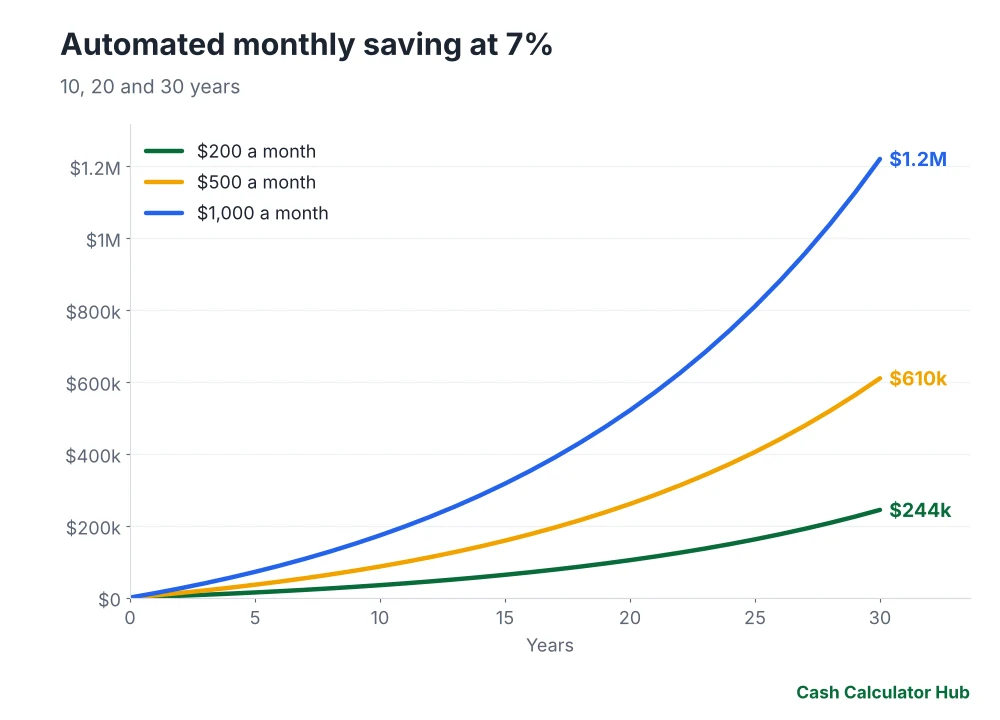
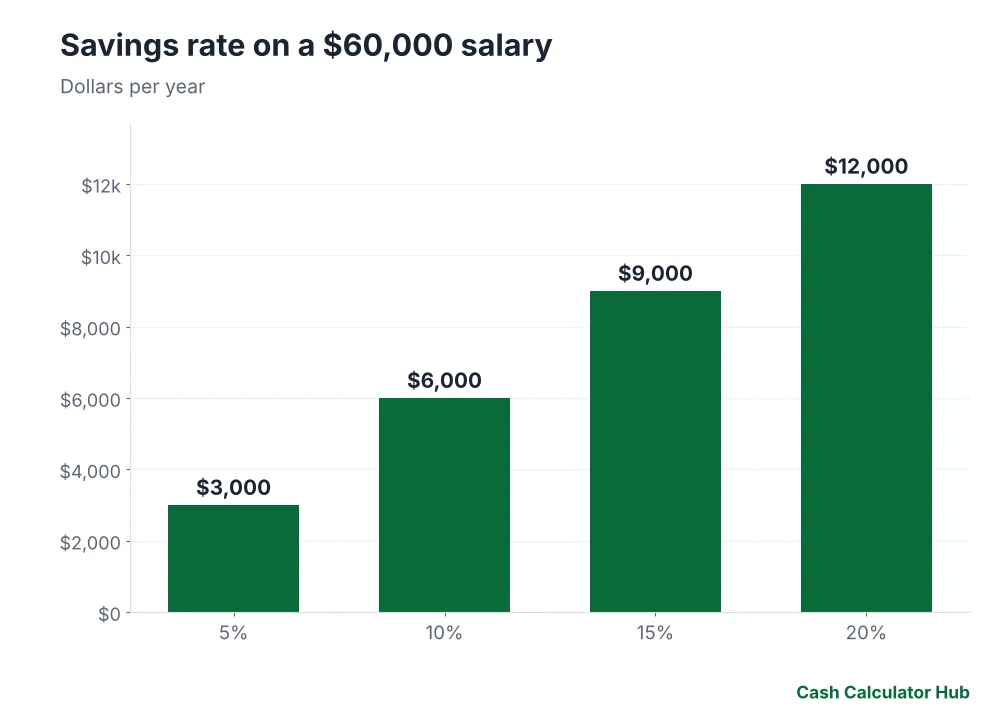
Quick answer: Pay yourself first means transferring a set amount to savings or investments as soon as you are paid, then spending what remains. Automating 10% of a $60,000 salary ($500 a month) at 7% grows to about $609,985 in 30 years. Automation removes the decision, which is why it works better than saving what is left.
Saving what is left at the end of the month rarely works because there often is none. Reversing the order, saving first and spending the rest, turns saving into a bill. The mechanics are simple and take less than an hour to set up.
Key takeaways
- Set up automatic transfers on payday, to accounts you do not see daily.
- Start with a number you can keep, then raise it with each raise.
- Order: employer match, emergency fund, high-interest debt, retirement accounts, other goals.
- Increase the rate 1% every few months or with raises.
- Review once a year.
What automation is worth
| Monthly amount | 10 years | 20 years | 30 years |
|---|---|---|---|
| $200 | $34,617 | $104,185 | $243,994 |
| $500 | $86,542 | $260,463 | $609,985 |
| $1,000 | $173,085 | $520,927 | $1,219,971 |
(7% annual return assumed; real returns vary.)
Set it up in four steps
- Choose the target. A common goal is 15% of gross income for retirement and 10% to 20% overall; start where you can. See savings benchmarks.
- Automate payroll deductions for the 401(k), at least to capture the match, and an HSA if eligible.
- Automate bank transfers for the emergency fund and goals, the day after payday.
- Automate increases. Many plans have auto-escalation; use it.
Priorities for the first dollars
- Employer match (an immediate return).
- Starter emergency fund; see how much to save.
- High-interest debt; see avalanche vs snowball.
- Roth or traditional IRA and the rest of the 401(k).
- Taxable investments and goals. Details in which account first.
Making the amount stick
- Start with 3% to 5% if 10% feels impossible, then add 1% every 3 months.
- Direct half of each raise to savings. On a 3% raise of $1,800 a year that is $900 more saved without lowering take-home.
- Name accounts for goals (house, car, travel).
Pitfalls
- Setting a rate so high you draw it back out.
- Keeping everything in one checking account.
- Forgetting to update after job changes.
- Neglecting the budget; a plan like the zero-based budget helps.
Tools
Use the savings calculator and retirement calculator to set targets, and the 401(k) calculator for payroll deferrals. More: budgeting tools.
Frequently asked questions
What does pay yourself first mean?
Saving or investing a fixed amount as soon as you are paid, before spending on anything else.
How much should I pay myself first?
A common target is 10% to 20% of income; start with what you can sustain and increase over time.
What is the best way to automate savings?
Use payroll deductions for retirement accounts and scheduled bank transfers for other goals.
Should I pay myself first or pay off debt?
Capture any employer match, build a starter emergency fund, then prioritize high-interest debt.
How do I save more without noticing?
Send part of each raise to savings and turn on automatic annual increases.
Sources and further reading
- MyMoney.gov: Financial literacy resources
- Consumer Financial Protection Bureau
- IRS: Retirement plans
How the numbers were made: Every figure on this page was calculated from the formulas and assumptions stated above and rounded to the nearest dollar. Rates, limits and rules are for 2026 unless noted; confirm current figures with the sources listed before acting.
Keep reading
- The 50/30/20 Budget Rule: How It Works, and How to Adjust It
- How Long Does It Take to Save $1 Million?
- Compound Interest on $10,000: What It Becomes in 10, 20 and 30 Years
- Sinking Funds: How to Save for Irregular Expenses Without Wrecking Your Budget
- Zero-Based Budgeting: Give Every Dollar a Job (With a Worked Example)
- How Much Rent Can You Afford? The 30% Rule, the 40× Rule and a Better Test
This guide is general information, not financial, tax or legal advice. Figures use stated assumptions and 2026 rules and will differ from your situation; check current rules and talk to a licensed professional before you decide. Full disclaimer.