Quick answer: Form W-4 tells your employer how much federal income tax to withhold. A $3,000 refund means about $250 a month was withheld that you could have used. The goal is to owe or be refunded close to zero: use the IRS Tax Withholding Estimator, update your W-4 after life changes and adjust Steps 3, 4(a), 4(b) or 4(c) as needed.
A refund feels like a bonus, but it is your own money returned without interest. At the other extreme, withholding too little can bring a bill and an underpayment penalty. Form W-4 is the lever you control.
Key takeaways
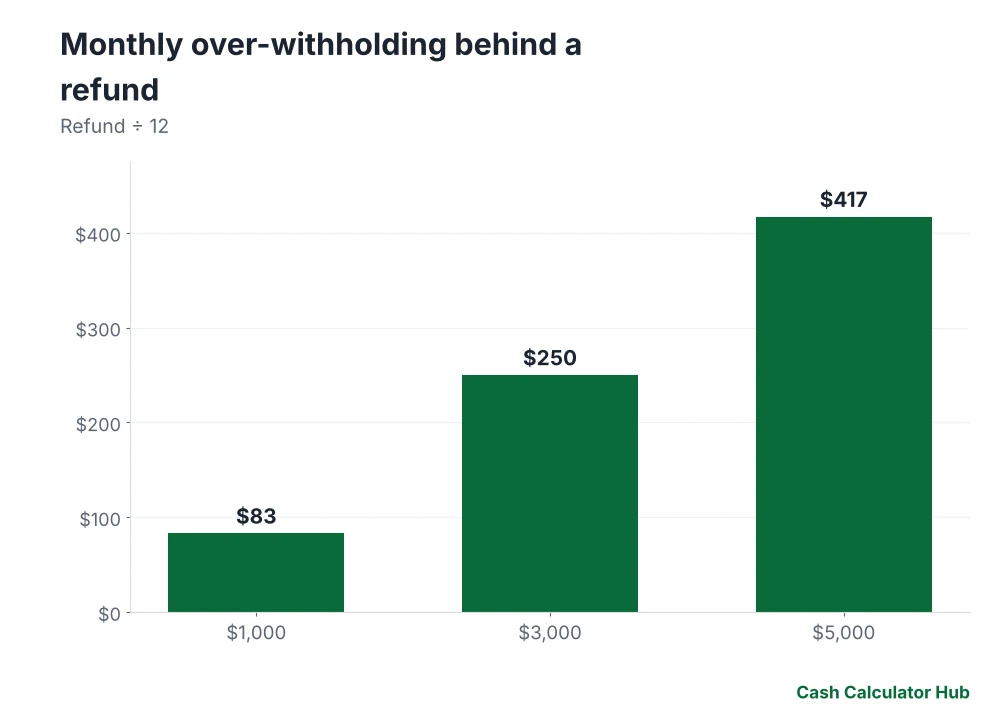
- A $3,000 refund = $250 per month withheld beyond what you owed.
- Update your W-4 after marriage, a new job, a second income, a child or large investment income.
- Step 2 handles multiple jobs or a working spouse; Step 3 claims credits; Step 4 adjusts income and deductions.
- The IRS Tax Withholding Estimator gives specific numbers to enter.
- You can avoid penalties by paying at least 90% of this year’s tax or 100% of last year’s (110% above $150,000 AGI).
What a refund really means
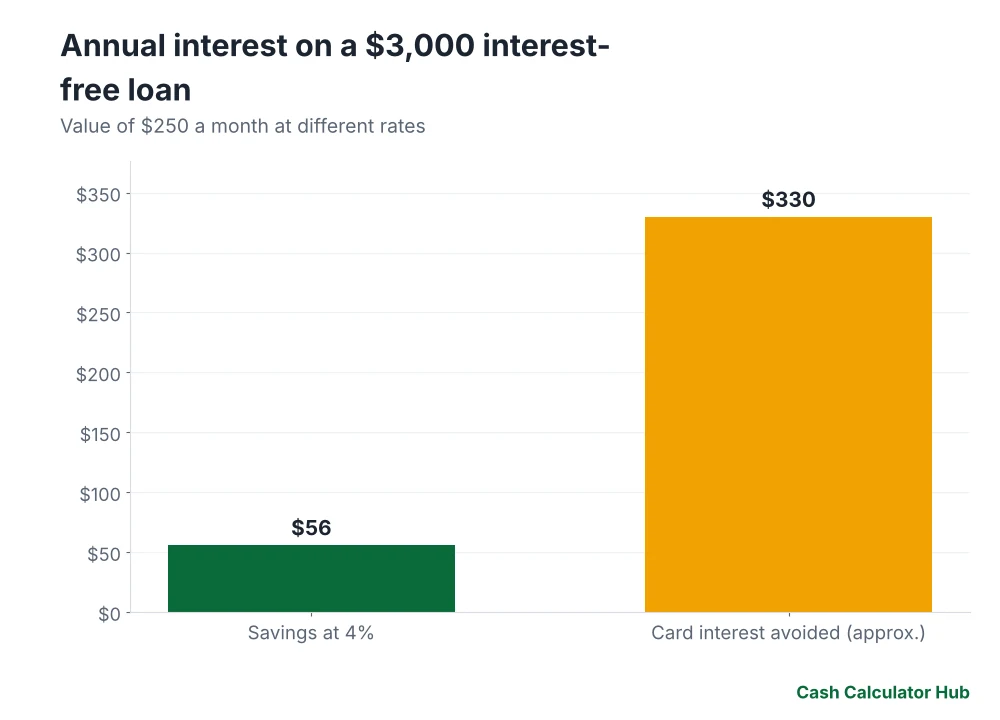
If you over-withhold $3,000 over the year, you gave the government an interest-free loan.
| Refund | Monthly over-withholding | Value if invested at 4% for the year (approx.) |
|---|---|---|
| $1,000 | $83 | $19 |
| $3,000 | $250 | $56 |
| $5,000 | $417 | $93 |
Interest on the monthly amounts is small, but the money could have paid off a credit card at 22% or filled an emergency fund; see card payoff and emergency funds.
The W-4 steps
| Step | Who needs it | What it does |
|---|---|---|
| 1 | Everyone | Filing status and personal information |
| 2 | Two jobs, or spouse works | Adjusts withholding for combined income (checkbox, estimator or worksheet) |
| 3 | Parents and others with credits | Child Tax Credit and other credits reduce withholding |
| 4(a) | Side income, interest, dividends | Other income not subject to withholding |
| 4(b) | Itemizers | Deductions beyond the standard deduction |
| 4(c) | Anyone | Extra withholding per pay period |
| 5 | Everyone | Sign and date |
See child tax credit for Step 3.
When to update
- Marriage or divorce
- New job or a spouse starts working
- Birth or adoption
- Buying a home (itemized deductions)
- Large side income or capital gains
- A big raise or bonus; see overtime and bonus withholding
How to get it right
- Gather your latest pay stub and last year’s tax return.
- Use the IRS Tax Withholding Estimator.
- Enter the results on a new Form W-4 and give it to your employer.
- Check again mid-year.
If you owe
You may owe an underpayment penalty if you pay less than 90% of this year’s tax or 100% of last year’s tax. Extra withholding is treated as paid evenly, which makes it useful late in the year. See quarterly estimates if you have side income.
Tools
The income tax calculator and paycheck calculator show your estimated tax and take-home. Read how to read your paycheck to see withholding. More: tax tools.
Frequently asked questions
What is Form W-4?
A form you give your employer that determines how much federal income tax is withheld from your paychecks.
How do I avoid a big tax refund?
Use the IRS Tax Withholding Estimator and update your W-4 so withholding matches your actual tax.
How often should I update my W-4?
After major life changes and at least once a year, such as when you review your finances.
Will I get a penalty if I owe at tax time?
Not if you paid at least 90% of this year’s tax or 100% of last year’s tax (110% for higher earners) through withholding and estimates.
What does Step 2 on the W-4 do?
It adjusts withholding for people with more than one job or a working spouse so the total is not under-withheld.
Sources and further reading
How the numbers were made: Every figure on this page was calculated from the formulas and assumptions stated above and rounded to the nearest dollar. Rates, limits and rules are for 2026 unless noted; confirm current figures with the sources listed before acting.
Keep reading
- 2026 Federal Tax Brackets and Standard Deduction, Explained With Examples
- How Much Is a $100,000 Salary After Taxes in 2026?
- Marriage Tax Penalty or Bonus: Who Pays More in 2026?
- Tax Deduction vs Tax Credit: Why a $1,000 Credit Beats a $1,000 Deduction
- Take-Home Pay on $50K, $75K and $150K Salaries (2026 Federal Taxes)
- Estate and Gift Tax Basics 2026: $15 Million Exemption and $19,000 Annual Gifts
This guide is general information, not financial, tax or legal advice. Figures use stated assumptions and 2026 rules and will differ from your situation; check current rules and talk to a licensed professional before you decide. Full disclaimer.