Quick answer: Split after-tax income 50% needs, 30% wants, 20% savings and debt.
Budgeting methods fail when they are too detailed to maintain. The 50/30/20 rule, popularized by Senator Elizabeth Warren and her daughter Amelia Warren Tyagi in All Your Worth, survives because it asks for three decisions instead of thirty.
The rule
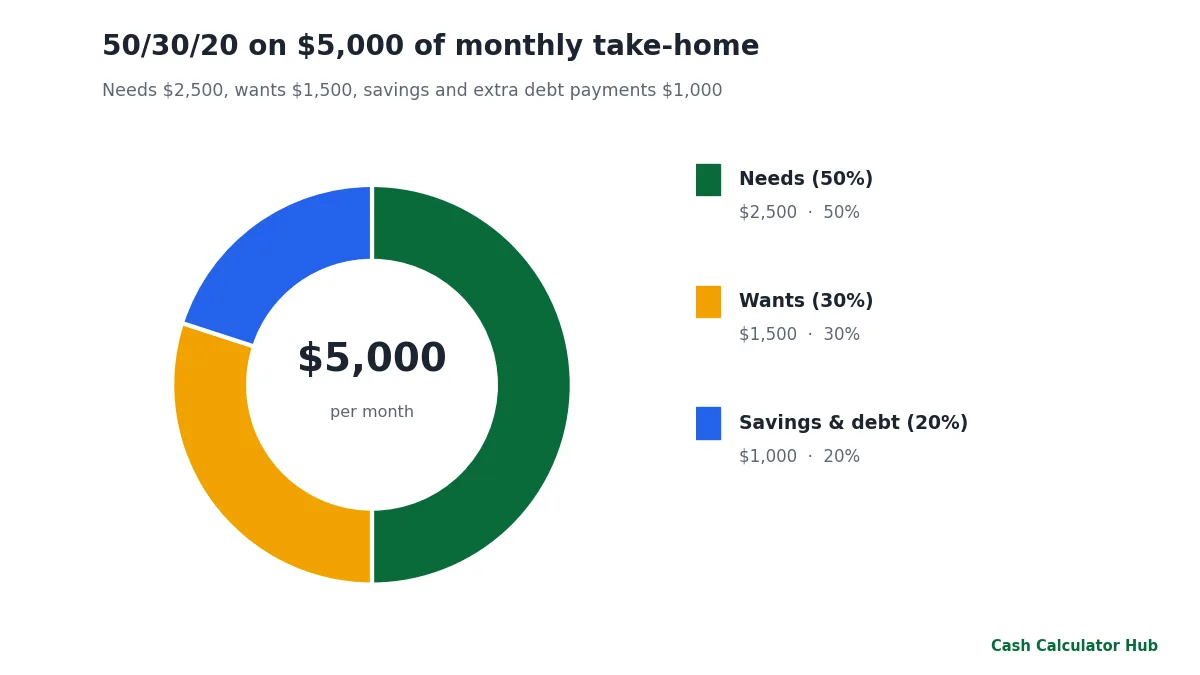
Split your after-tax income (take-home pay) into three buckets:
- 50% needs: things you must pay to live and work.
- 30% wants: everything optional.
- 20% savings and debt payoff: emergency fund, retirement, extra debt payments.
What counts as a need
Housing (rent or mortgage, insurance, utilities), groceries, transportation to work, minimum debt payments, basic insurance, and childcare if you need it to work. Cable, restaurants, subscriptions and most of your phone plan’s premium features are wants. Some items sit in between: groceries are a need, but a lot of the grocery bill’s upmarket options are wants.
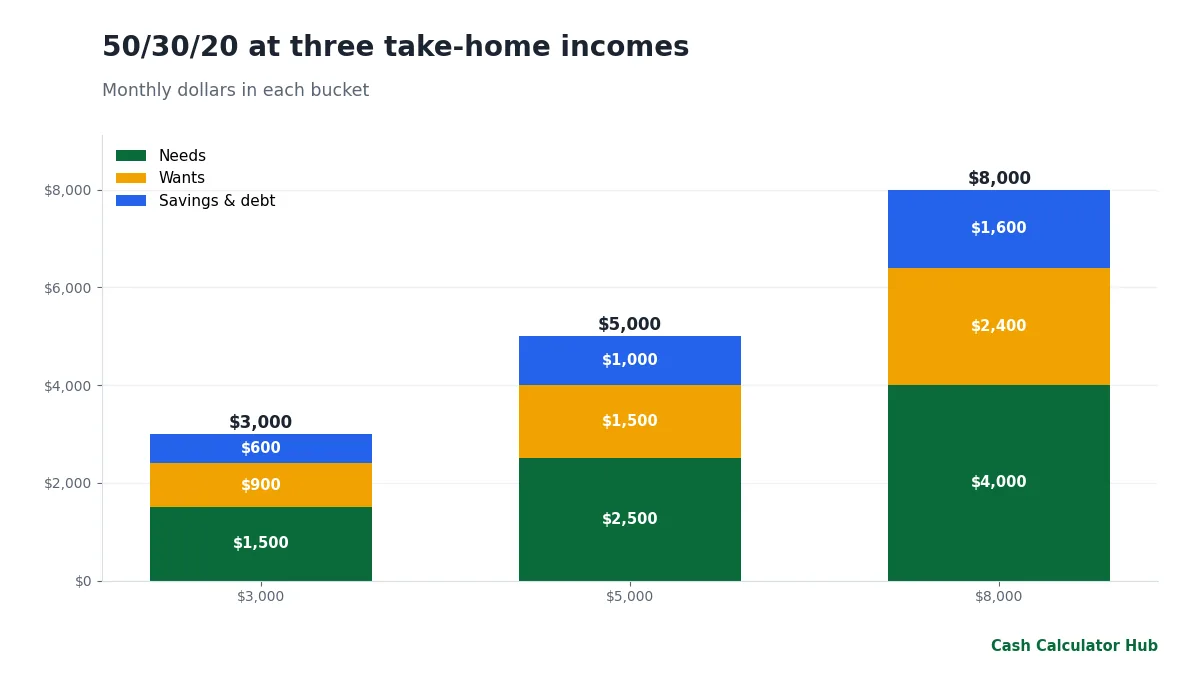
The dollars at three incomes
| Take-home / month | Needs (50%) | Wants (30%) | Savings & debt (20%) |
|---|---|---|---|
| $3,000 | $1,500 | $900 | $600 |
| $5,000 | $2,500 | $1,500 | $1,000 |
| $8,000 | $4,000 | $2,400 | $1,600 |
Where it breaks down
- High-cost cities. Rent alone can be 40% of take-home. The rule does not fit well. Try 60/20/20 or 60/15/25.
- Heavy debt. If you carry credit card debt at 22%, putting 20% toward it is better than any savings plan. Use the debt payoff calculator to plan it.
- Low income. If needs already take 70%, the answer is not to feel guilty; it is to find ways to raise income or lower costs.
- High income. When income is high, 20% savings may be too low. Many people aim for 25% to 30%.
Adjusting it for your life
- Calculate your actual numbers first. Track one month. Most people are surprised by the wants.
- Choose a flexible ratio that you can hold. A rule you follow at 60/25/15 beats one you abandon at 50/30/20.
- Automate the 20%. Set transfers on payday for savings and investment.
- Order the 20%: starter emergency fund ($1,000), employer 401(k) match, high-interest debt, a fuller emergency fund (3 to 6 months), then more retirement. See the 2026 retirement limits.
- Review every few months. Raises, rent changes and children all shift the numbers.
The common mistake: using gross income
The rule applies to take-home pay. If you earn $100,000 and your paycheck deposit is about $6,300 a month, your 50% is $3,150, not $4,166. See what $100,000 is after taxes and check your number with the take-home paycheck calculator.
Build yours
Use the 50/30/20 budget planner with your own percentages and a savings goal. For a line-by-line plan with categories, the budget calculator compares each category with common guidelines. Housing is usually the largest line; test your own limits with the house affordability guide. If you want to see how long it will take to reach a savings goal, try the savings calculator. More: budget and planning tools.
Alternatives when 50/30/20 does not fit
| Plan | Needs | Wants | Savings & debt | Best for |
|---|---|---|---|---|
| 50/30/20 | 50% | 30% | 20% | Mid-range incomes |
| 60/20/20 | 60% | 20% | 20% | High housing costs |
| 70/20/10 | 70% | 20% | 10% | Tight budgets |
| 40/20/40 | 40% | 20% | 40% | Aggressive savers |
A sample $5,000 month
Rent $1,450, utilities and phone $200, groceries $450, transportation $250, insurance $150 (about $2,500 in needs); dining out and entertainment $500, shopping $400, subscriptions and hobbies $300, travel fund $300 (about $1,500 in wants); $400 retirement, $300 emergency fund and $300 extra debt payment (about $1,000 in savings and debt). The categories matter less than the percentages. Track for two months, adjust and automate. If a number looks off, check it in the budget calculator.
Is 50/30/20 realistic?
For middle incomes in lower-cost areas, yes. In high-cost areas, needs often exceed 50%.
Do I include taxes?
No. The percentages apply after taxes and payroll deductions.
Where does a 401(k) contribution go?
Into the 20% bucket. If it is deducted from your paycheck before take-home, it counts toward the 20% even though you never see it.
Should I pay debt or save first?
Build a small emergency fund, capture any match, then attack debt with rates above about 8%.
Sources and further reading
- MyMoney.gov: Financial literacy resources
- Consumer Financial Protection Bureau
- BLS: Consumer Expenditure Surveys
How the numbers were made: Every figure on this page was calculated from the formulas and assumptions stated above and rounded. Rates, limits and rules are for 2026 unless noted; confirm current figures with the sources listed before acting.
Keep reading
- 2026 401(k) and IRA Contribution Limits, Explained
- How Much Is a $100,000 Salary After Taxes in 2026?
- How Much House Can I Afford on a $100K Salary?
- How Much Down Payment Do You Really Need for a House?
- How Much Car Can I Afford? The 20/4/10 Rule With Real Numbers
- Savings Account vs CD: Which Earns More for Your Cash?
This guide is general information, not financial, tax or legal advice. Figures use stated assumptions and 2026 rules and will differ from your situation; check current rules and talk to a licensed professional before you decide. Full disclaimer.