
Quick answer: $100 in 2000 equals about $195 today using BLS CPI data through August 2026.
A dollar is not a fixed amount of stuff. The same $100 bought much more in 2000 than it does now. Inflation measures how fast that changes, and the math to convert between years is straightforward.
The formula
Value today = amount × (CPI today ÷ CPI in the earlier year)
CPI is the Consumer Price Index for All Urban Consumers (CPI-U) from the Bureau of Labor Statistics. The annual average for 2000 was 172.2. The index for August 2026 was 334.98. So $100 in 2000 becomes $100 × (334.98 ÷ 172.2) = $195.
What $100 buys today, by starting year
| From | CPI | Equivalent in Aug 2026 |
|---|---|---|
| 2000 | 172.2 | $194.53 |
| 2005 | 195.3 | $171.52 |
| 2010 | 218.056 | $153.62 |
| 2015 | 237.017 | $141.33 |
| 2020 | 258.811 | $129.43 |
| 2024 | 313.689 | $106.79 |
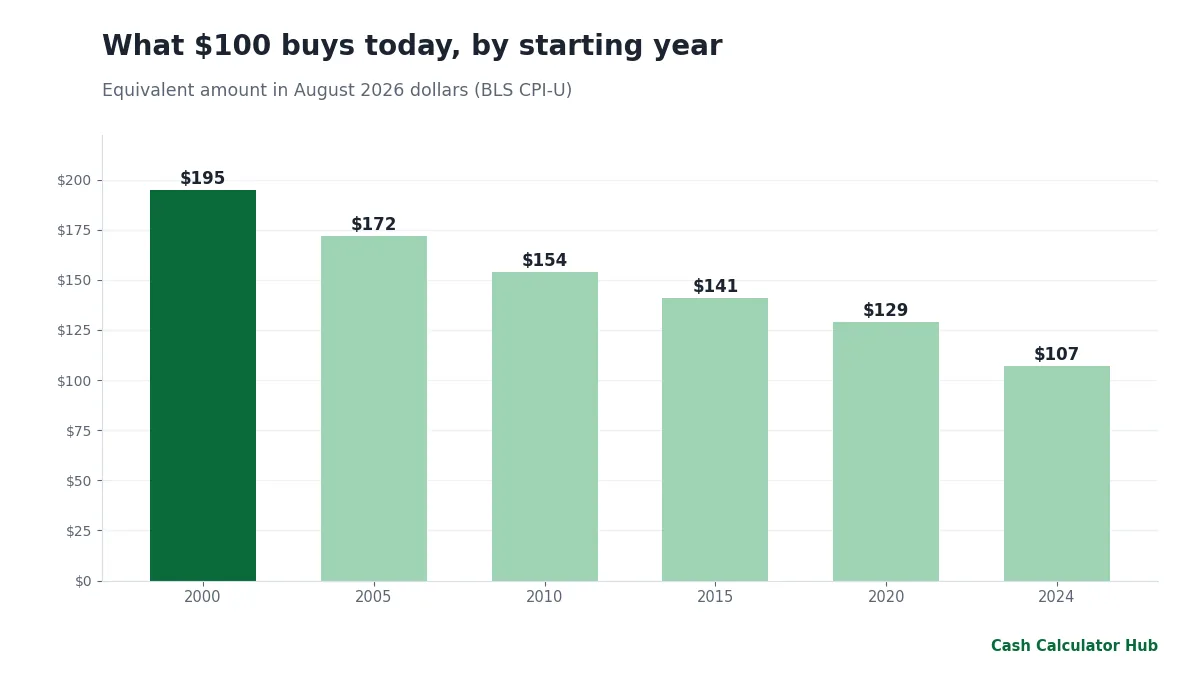
Since 2000 prices have risen about 95%, or an average of 2.5% per year. Since 2020, they are up 29%, the fastest stretch in four decades. That surge is why many people feel their paychecks buy less even when raises look decent.
The latest reading
The BLS reported that consumer prices in August 2026 were up 3.4% from a year earlier, the same pace as in July and well above the 2% target the Federal Reserve aims for. Core inflation, which excludes food and energy, was lower at 2.4%. An energy price spike earlier in the year pushed the annual rate well above 3.5% in the spring. Check the BLS for the newest release.
What inflation does to cash
At 3.4% a year, $100 sitting in a drawer loses about half its purchasing power in 20 years:
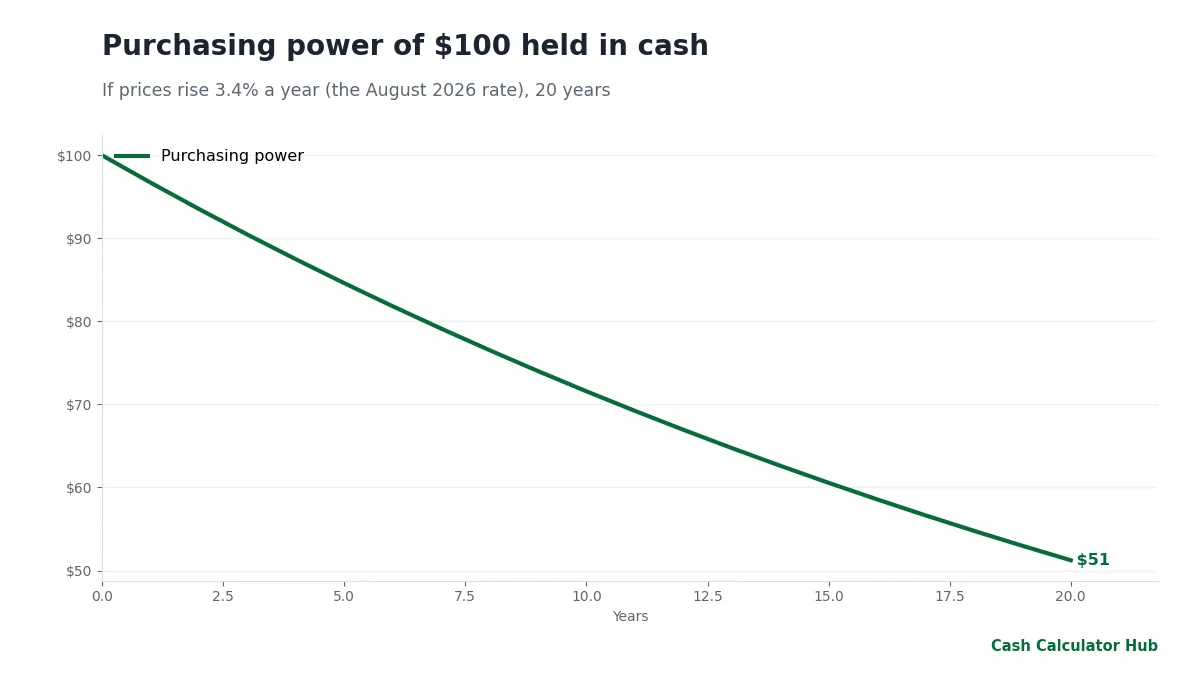
A savings account paying around 4% roughly keeps pace, before taxes. That is the reason people keep money they will not need for decades in assets with higher expected returns, while accepting more risk. Compare cash options in savings accounts and CDs, and growth options in what $10,000 becomes over time.
Inflation and your money plans
- Retirement: if you want $60,000 a year in today’s dollars, in 30 years at 3% you need about $145,636. See how much you need to retire.
- Salary: a 3% raise in a 3.4% inflation year is a pay cut in real terms.
- Debt: fixed-rate debt gets easier to pay over time because you repay with cheaper dollars, which is a reason mortgages are not all bad news.
- College and healthcare: these categories have often risen faster than average CPI.
Limits of CPI
CPI is an average basket. Your personal inflation depends on what you spend on. A renter in a fast-rising market feels more inflation than a homeowner with a fixed mortgage. Many other indexes exist, and CPI methodology is debated. For personal decisions, track your own major costs.
Try it
Use the inflation calculator to convert any amount between years and see average annual inflation. The percentage calculator helps with price changes and the present value calculator discounts future money. If you are comparing cities, the cost of living guide explains geographic differences. See currency and inflation tools.
Assets that have tried to keep pace
- Treasury Inflation-Protected Securities (TIPS) adjust principal with CPI.
- Series I bonds pay a rate that includes inflation, with purchase limits and holding rules.
- Stocks have historically outpaced inflation over long periods, with volatility along the way.
- Real estate often rises with prices over time, though it comes with costs and local risk.
- Your own earning power. Raises that match or beat inflation matter most.
Using inflation in your negotiations
If your pay has risen 9% since 2020 and prices rose about 29%, your real income has fallen. Present that arithmetic calmly, along with your performance, when you ask for a raise. The percentage calculator gives you the percentage change in two seconds.
Inflation and fixed incomes
People on fixed pensions without cost-of-living adjustments lose purchasing power every year, which is one reason Social Security’s annual COLA is valuable. See the Social Security claiming guide for how the timing affects the base your COLAs build on.
What is the current US inflation rate?
The August 2026 CPI was 3.4% above August 2025, according to BLS data released on September 11, 2026. Check the BLS site for any newer release.
What is $1 in 1980 worth now?
CPI averaged about 82.4 in 1980, so $1 then equals about $4.07 at the August 2026 index (334.98 ÷ 82.4). Use the calculator for any other year.
Does inflation affect everyone equally?
No. It depends on what you buy and whether your income rises with prices.
Is some inflation good?
Central banks target about 2% because it leaves room to cut rates in a downturn and avoids deflation risks.
Sources and further reading
How the numbers were made: Every figure on this page was calculated from the formulas and assumptions stated above and rounded. Rates, limits and rules are for 2026 unless noted; confirm current figures with the sources listed before acting.
Keep reading
- Savings Account vs CD: Which Earns More for Your Cash?
- Compound Interest on $10,000: What It Becomes in 10, 20 and 30 Years
- How Much Do You Need to Retire? A Practical Way to Find Your Number
- Percentage Increase and Decrease: Formulas, Examples and the 20% Trap
- CPI Explained: How Inflation Is Measured and What the Number Misses
- Successive Discounts: Why 20% Off Plus 10% Off Is Not 30% Off
This guide is general information, not financial, tax or legal advice. Figures use stated assumptions and 2026 rules and will differ from your situation; check current rules and talk to a licensed professional before you decide. Full disclaimer.

